
UHF 
Alien Higgs-9
For asset tracking, automotive, aviation and mass tagging with additional user memory.
Security PWD
Memory 96–496 bit EPC
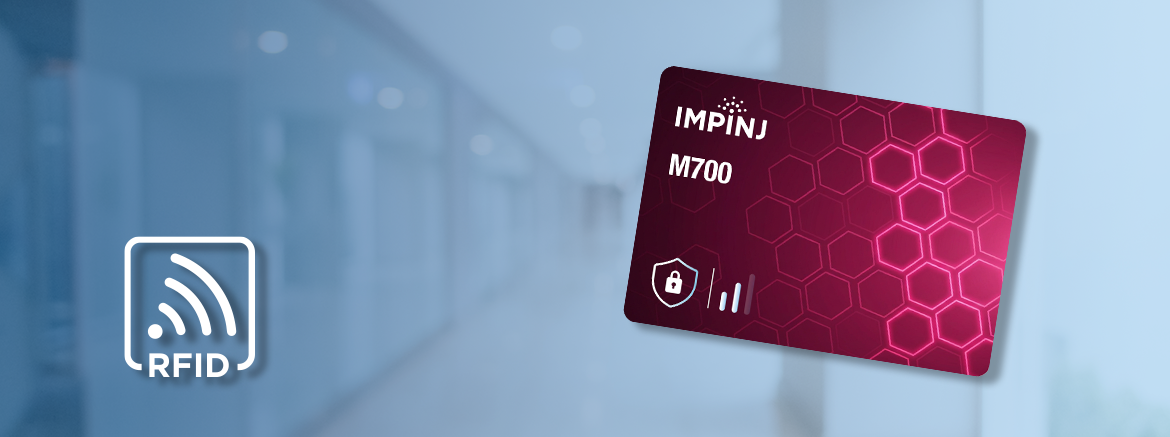
The Impinj M700 Series is a family of passive UHF RFID chips for RAIN RFID applications in the frequency range 860 to 960 MHz. It operates according to ISO/IEC 18000-63 and EPCglobal Gen2v2. The variants M730, M750 and M770 include different memory configurations with 96 or 128 bits of EPC memory and up to 32 bits of user memory. The variants M780 and M781 expand the memory to up to 496 bits of EPC and 512 bits of user memory respectively. Impinj positions the chips for fast inventories, retail applications, loss prevention and item-level tagging, among other things.
For new UHF projects, the M700 series is particularly interesting when high read sensitivity, fast detection of large tag populations and compact inlays are required. We recommend the Impinj M700 series for retail, inventory and item-level tagging. For M730, M750, M770, M780 and M781, protection is based on Gen2v2 access controls and a 32-bit password, not on cryptographic authentication such as AES.
| Feature | Value |
|---|---|
| Manufacturer | Impinj, Inc. |
| Product family | Impinj M700 Series |
| Type designation | M730 / M750 / M770 / M780 / M781 |
| RFID class | UHF |
| Frequency | 860–960 MHz |
| Standard | RAIN RFID / ISO/IEC 18000-63:2015 / EPCglobal Gen2v2 |
| EPC Memory | M730: 128 bits; M750: 96 bits; M770: 128 bits; M780: 496 bits; M781: 128 bits |
| User Memory | M730: none; M750: 32 bits; M770: 32 bits; M780: 128 bits; M781: 512 bits |
| TID | M730/M750/M770: 96-bit serialized TID with 48-bit serial number |
| Memory structure | Reserved, EPC, TID and, depending on the variant, user memory |
| Authentication | Password-based Gen2v2 access control; no AES authentication for M730/M750/M770/M780/M781 |
| Access / kill password | A shared 32-bit password for access and kill |
| Anti-collision | Yes, according to EPCglobal Gen2v2 / ISO/IEC 18000-63 |
| Read sensitivity | Up to −24 dBm (M780/M781: −23.5 dBm) with dipole antenna |
| Write sensitivity | M730/M750/M770: up to −21 dBm with dipole antenna |
| Read range | Depends on inlay antenna, reader, transmission power and environment; UHF systems typically allow several meters |
| Write cycles | M730/M750: 10,000; M770/M780/M781: 100,000 |
| Data retention | M730/M750: 10 years; M770/M780/M781: 20 years |
| Protected Mode | Yes, tag can be silenced to RAIN RFID readers and reactivated |
| Short-Range Mode | Yes, reduces the normal read range to less than one tenth |
| AutoTune | Impinj Enhanced AutoTune V2 |
| Smartphone NFC | No, not directly readable with normal smartphone NFC |
| Product status at Impinj | Current M700 product family |
| Typical media | UHF inlays, RFID labels, stickers and special transponders |
| Security rating | PWD |
| Recommendation | Recommended for retail, inventory and item-level tagging |
The variants M730, M750 and M770 differ mainly in memory. M730 offers a 128-bit EPC without user memory, M750 a 96-bit EPC plus 32 bits of user memory and M770 a 128-bit EPC plus 32 bits of user memory. All three have a 96-bit serialized TID with a 48-bit serial number. According to Impinj, read sensitivity is up to −24 dBm and write sensitivity up to −21 dBm.
The variants with extended memory offer significantly more space for additional product data such as batch, date or weight: M780 with a 496-bit EPC and 128 bits of user memory, M781 with a 128-bit EPC and 512 bits of user memory. Both are specified for 100,000 write cycles and 20 years of data retention.
The M700 Series is designed for the fast identification of individual items and large tag populations. Impinj names in particular inventories, loss prevention, self-checkout, returns processes and applications at goods exits, conveyor systems and store exits.
Typical applications are:
The chips are typically integrated into UHF inlays, RFID labels and stickers – Impinj lists partner products with M730, M750 and M770 as inlays, labels and stickers, among others.
Security level: Medium / PWD
The variants M730, M750 and M770 as well as the memory variants M780 and M781 have no AES-based cryptographic authentication. A single 32-bit password is available for access protection and the kill function. A special feature of the M700 series is that the access password and kill password use the same physical password value. This value is set to zero at the factory.
The password can secure memory access and permanently deactivate a tag with the kill command. In addition, the series supports Impinj Protected Mode, in which a tag can be made completely invisible to normal RAIN RFID readers and reactivated with the correct command sequence. Short-Range Mode reduces the range to less than one tenth of normal operation and can therefore also contribute to privacy.
These functions are useful for product tagging, inventory and many retail processes, but do not amount to cryptographic product authentication. If the authenticity of a product is to be proven cryptographically, within the M700 family only the M775 is equipped with the cryptographic authentication Impinj Authenticity. Alternatively, NXP UCODE DNA offers AES-128-based authentication for track-and-trace applications with increased security requirements.
| Advantages | Disadvantages |
|---|---|
| Read sensitivity up to −24 dBm | No cryptographic AES authentication for M730/M750/M770/M780/M781 |
| Designed for fast inventories and large tag populations | Only 0 or 32 bits of user memory for M730/M750/M770; more memory only for M780/M781 |
| Protected Mode and Short-Range Mode for privacy and retail processes | Access and kill use the same 32-bit password |
| AutoTune V2 adapts the RF tuning to the environment | Not directly readable with normal smartphone NFC |
| RAIN RFID, ISO/IEC 18000-63 and EPCglobal Gen2v2 | Read range highly dependent on inlay, reader and operating environment |
Depending on the application, memory requirements, read range and security needs, other chip types may be better suited. However, switching from UHF to HF/NFC is not a direct chip replacement and requires different readers.
For asset tracking, automotive, aviation and mass tagging with additional user memory.
For track and trace with increased security requirements.
For NFC marketing, business cards and smartphone applications.

Do you need UHF RFID labels, inlays or other RFID media with Impinj M700? For the selection, the desired media format and quantity, existing reader infrastructure, operating environment, required EPC and user memory as well as requirements for encoding and read range are particularly relevant.
Data as of: October 2026
The technical information is based on the official Impinj M700 Series: Tag Chip Datasheet, Version 6.4, © 2024, for Impinj M730, M750 and M770, the current Impinj product page, the current M700 Series Product Brief and the Impinj M700 Series specification table for M775, M780 and M781. Among other things, the data sheet specifies ISO/IEC 18000-63:2015 and EPCglobal Gen2v2, the memory configurations, TID, read and write sensitivity as well as Protected Mode and the password functions.
Impinj, Monza, RAIN, AutoTune, Integra, FastID, TagFocus and other product and brand names mentioned may be trademarks of their respective owners.