RFID Labels

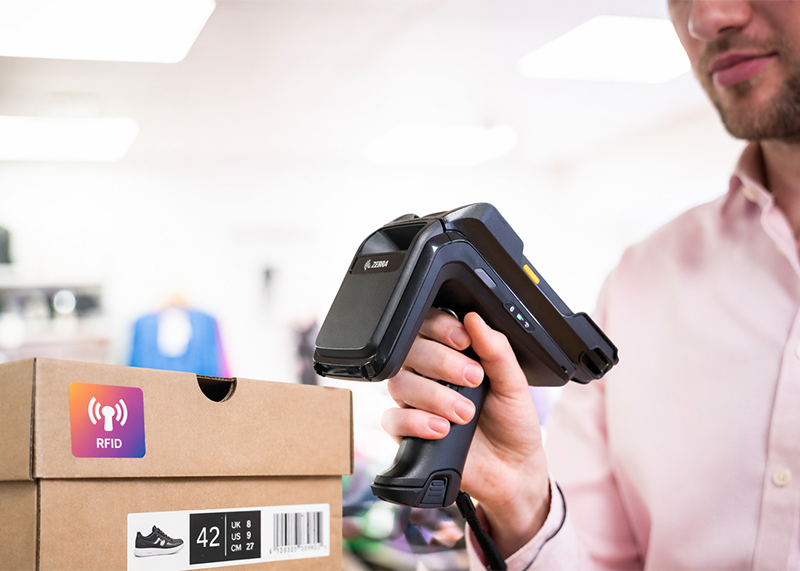
RFID Aufkleber mit Scanner

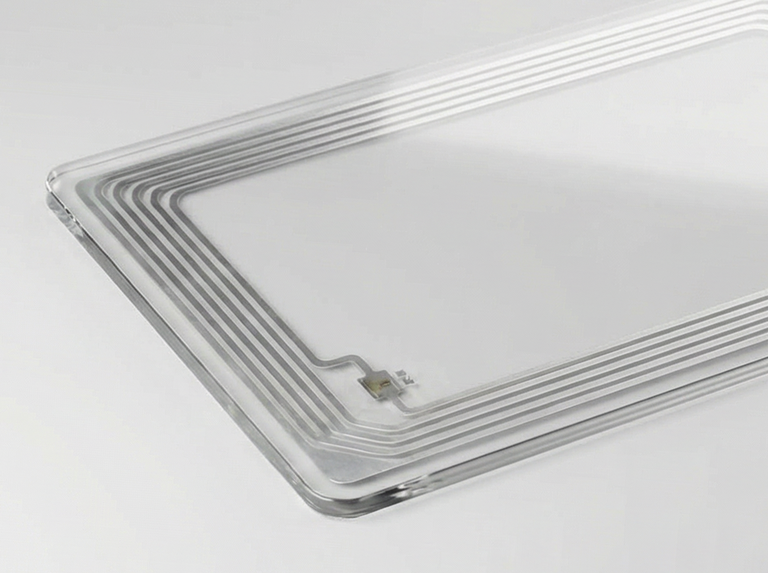
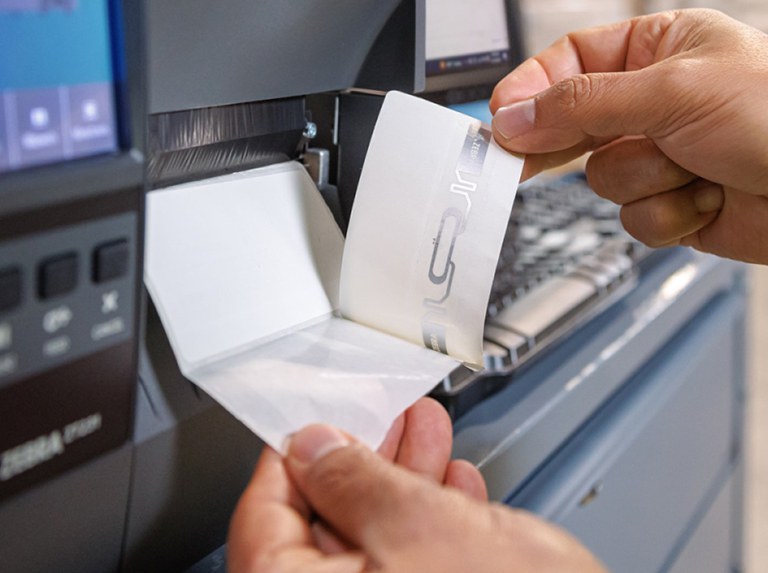
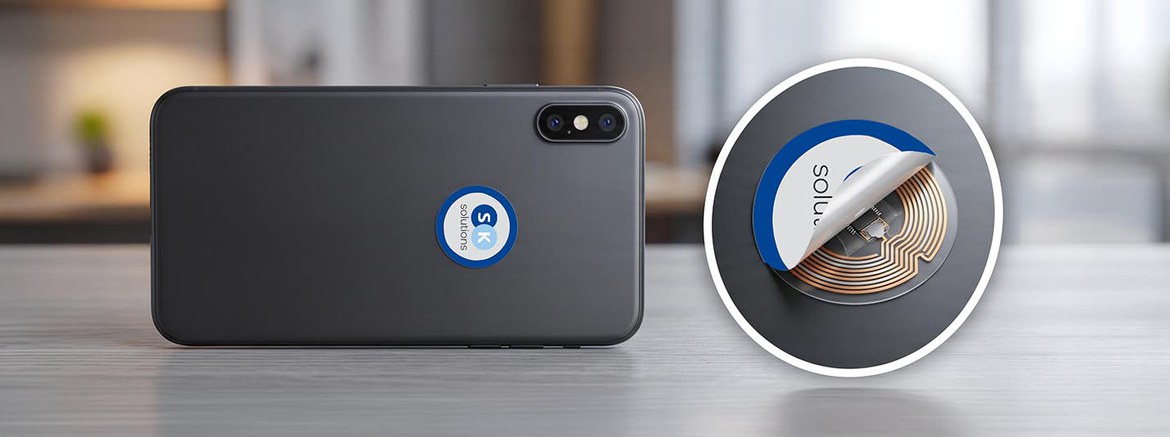
RFID stickers (also known as RFID tags, RFID labels or RFID tags) are self-adhesive data carriers that combine an RFID chip with an antenna within a thin film or paper label. Unlike traditional RFID chip cards, RFID stickers can be applied flexibly and discreetly to almost any surface – from packaging and products to vehicles, documents and machinery. Contactless data transmission via radio waves eliminates the need for a line of sight to the reader, meaning that RFID labels can be reliably read even when positioned behind adhesive films, inside packaging or embedded within a product. RFID stickers are therefore the ideal solution for businesses seeking a cost-effective, fast and automatable labelling system for logistics, production, inventory management or anti-theft protection.


REQUEST OFFER

RFID labels for tracking and anti-theft protection

RFID labels can be used for product identification, as electronic delivery notes and for tracking throughout the supply chain. In logistics, they enable end-to-end traceability of goods from the manufacturer to the end customer. When attached to loaned items or mobile phones, RFID tags ensure that location tracking and identification are possible at all times.

In the retail sector, RFID labels are used to protect goods against theft: if someone leaves the shop with unpaid goods, a reader detects the RFID label and triggers an alarm. Furthermore, conventional plastic cards without built-in technology can be retrofitted with RFID stickers to add a contactless function.


RFID stickers as a marketing tool

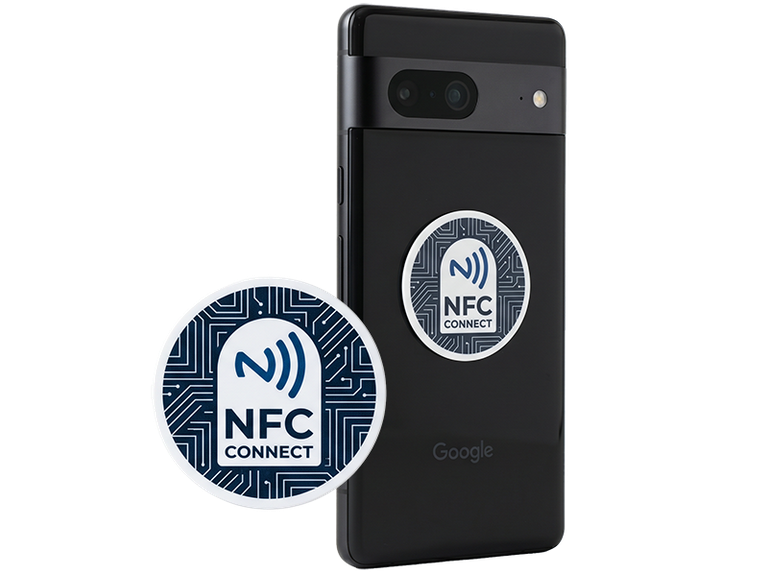
RFID labels have long since become more than just labelling solutions – NFC-enabled RFID labels (known as NFC tags) in particular open up a wide range of possibilities in marketing. By scanning with a smartphone, customers can be directed straight to product pages, landing pages, discount offers or digital content. Packaging, promotional materials and displays thus become interactive touchpoints that foster dialogue between the brand and the consumer. Thanks to customised printing and electronic encoding, every RFID label can be designed as a personalised marketing medium – measurable, scalable and seamlessly integrable into digital campaigns.

RFID Aufkleber Trenner

Printing, coding and personalisation of RFID labels

RFID labels can be customised to meet your specific requirements. As well as printing logos, text, barcodes and QR codes, we offer electronic encoding (EPC encoding, UID programming) and serialisation of each individual RFID tag. This ensures you receive a label that is uniquely identifiable both visually and electronically. A special protective coating ensures abrasion-resistant and long-lasting print quality – even under demanding operating conditions.

Complete RFID solutions from All About Cards

All About Cards offers you RFID system solutions from a single source. As well as RFID labels in all standard frequencies and materials, we also supply compatible RFID readers, software integrations and our first-class consultancy service. Our experts will be happy to provide you with a free, no-obligation quote – from a single roll right through to large-scale production.

FAQ on RFID Labels
FAQ RFID Aufkleber


How do RFID stickers and RFID tags work?
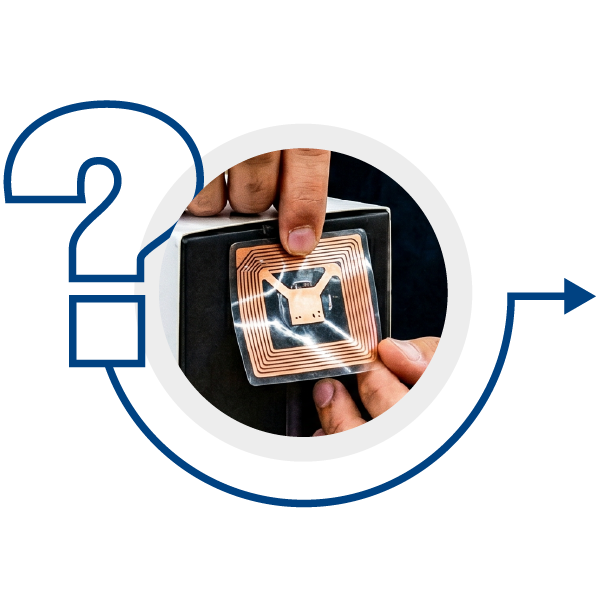
RFID stands for "Radio-Frequency Identification" and refers to identification using electromagnetic waves. An RFID tag consists of two core components: a microchip (memory) and an antenna, which together form what is known as an RFID transponder. This transponder is passive – it does not require its own battery, but draws its energy wirelessly from the electromagnetic field of the RFID reader.
As soon as an RFID tag is within range of a compatible reader, the chip is powered via the antenna and transmits its stored data (e.g. a unique serial number, EPC code or UID). This process takes just milliseconds and works even through materials such as cardboard, plastic or textiles. A key advantage over traditional barcodes is that RFID labels do not need to be scanned individually – multiple labels can be read simultaneously using a process known as bulk reading.
Active vs. passive RFID tags
In the field of RFID labels, passive transponders are used almost exclusively. They are particularly thin, cost-effective and maintenance-free, as they do not require their own power source. Active RFID tags have a built-in battery and achieve significantly greater ranges (up to 100 metres), but are bulkier and more expensive. For most applications involving RFID labels – such as logistics, stock-taking and anti-theft – passive tags are the more cost-effective choice.
How does RFID work?
RFID is based on the transmission of data via electromagnetic waves. A reader generates an electromagnetic field that powers the passive RFID chip. The chip then transmits its stored data back to the reader via the antenna. This process takes place contactlessly, without line of sight, and in milliseconds – even through materials such as cardboard, plastic or textiles.
How can I protect an RFID tag against theft and tampering?
There are special tamper-proof RFID stickers available for this purpose, known as tamper-proof RFID labels. These stickers can be fitted with a special tamper-proof mechanism which causes the RFID label to self-destruct in the event of any attempt at tampering. Any attempt to remove the sticker without damaging it irreversibly deactivates the chip. This technology is used, for example, as a driving licence label for automated driving licence checks. All About Cards manufactures security labels suitable for driving licences using both HF and UHF technology. Tamper-proof RFID tags are also suitable for warranty seals, pharmaceutical security labels and the protection of high-value products against counterfeiting.
How do I find the right RFID sticker?
There are special tamper-proof RFID stickers available for this purpose, known as tamper-proof RFID labels. These stickers can be fitted with a special tamper-proof mechanism which causes the RFID label to self-destruct in the event of any attempt at tampering. Any attempt to remove the sticker without damaging it irreversibly deactivates the chip. This technology is used, for example, as a driving licence label for automated driving licence checks. All About Cards manufactures security labels suitable for driving licences using both HF and UHF technology. Tamper-proof RFID tags are also suitable for warranty seals, pharmaceutical security labels and the protection of high-value products against counterfeiting.
Which frequency range is suitable for my application?
Choosing the right frequency band is crucial for the performance and intended use of your RFID labels. There are essentially three frequency bands available:
LF – Low Frequency (125 kHz)
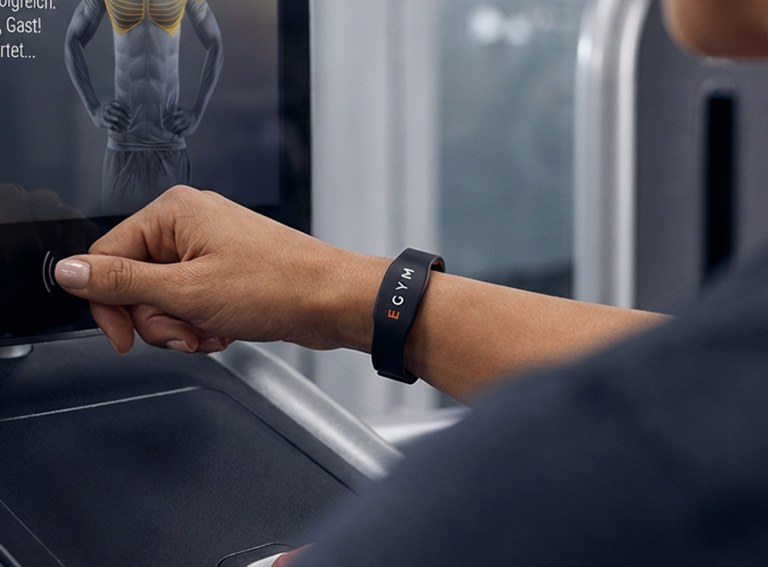
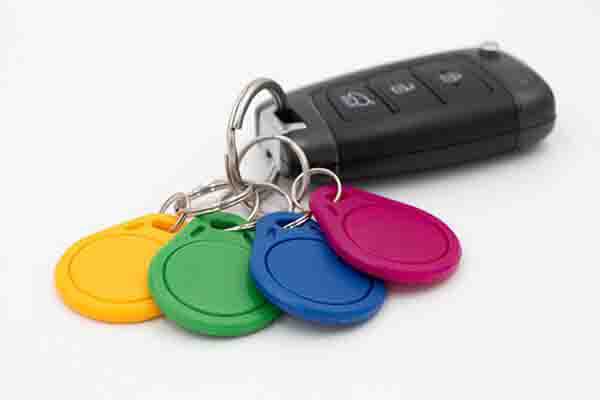
RFID tags in the LF band operate at 125 kHz and offer a read range of just a few centimetres. They are characterised by a high degree of immunity to metal and liquids and are particularly suitable for access control, animal identification and applications where a short read range is required.
HF – High Frequency / NFC (13,56 MHz)
RFID tags using HF technology (13.56 MHz) have a read range of up to 30 cm. These also include NFC (Near Field Communication) tags, which are additionally compatible with smartphones. Typical chip types include NTAG213, NTAG215, NTAG216, MIFARE Classic and ICODE SLIX. HF/NFC RFID labels are ideal for product authentication, visitor management, library systems, ticketing and smart packaging applications.
UHF – Ultra High Frequency (860–960 MHz)
For applications requiring long read ranges (up to 12 metres and beyond), UHF RFID tags are the first choice. They enable bulk reading of large quantities in a fraction of a second and are the standard in warehouse and logistics processes, supply chain management, stock-taking and retail anti-theft systems. Common UHF chips include the Impinj Monza, NXP UCODE and Alien Higgs.
What materials and finishes are available for RFID stickers?
Choosing the right material has a decisive impact on the durability, read performance and range of applications for your RFID labels. All About Cards offers RFID labels in the following material variants: RFID paper labels. Paper labels are the most cost-effective option for applications not subject to extreme environmental conditions. They are ideal for dispatch labels, inventory labels and short-term labelling in dry indoor environments. RFID labels made from film (PET/PP) Film-based RFID labels offer significantly greater resistance to moisture, chemicals, UV radiation and mechanical abrasion. They are the recommended choice for outdoor applications, industrial environments and wherever durable labelling is required. On-Metal RFID Tags Conventional RFID stickers can suffer from interference on metallic surfaces, as metal reflects radio signals. Specialised on-metal RFID tags feature a shielding intermediate layer that enables reliable data transmission even when applied directly to metal. Ideal for labelling machinery, tools, IT equipment and metal containers.
How much do RFID stickers cost?
The cost of RFID labels varies depending on the frequency range, chip type, material, quantity and level of customisation. Simple passive UHF RFID labels start at just a few cents each when purchased in large quantities. HF/NFC labels and specialised labels (on-metal, tamper-proof) are more expensive. Please request a personalised quote to find out the exact unit price for your requirements.
What are the advantages of RFID labels over barcodes?
RFID labels offer numerous advantages over conventional barcodes, making them the superior solution for modern identification and logistics processes. Whilst barcodes must be scanned individually and require a direct line of sight, RFID tags can be read without line-of-sight contact and in bulk. RFID labels are rewritable, store significantly more data and work even through packaging materials. Furthermore, RFID labels offer greater protection against counterfeiting and enable real-time stock tracking, which would not be possible with barcodes.
What are the disadvantages of RFID tags?
NFC (Near Field Communication) ist eine Untergruppe der RFID-Technologie und arbeitet auf der Frequenz 13,56 MHz mit einer Reichweite von wenigen Zentimetern. Der entscheidende Unterschied: NFC-Tags können auch mit handelsüblichen Smartphones ausgelesen und beschrieben werden, während andere RFID-Frequenzen (LF, UHF) spezielle Lesegeräte erfordern. NFC-fähige RFID Aufkleber eignen sich besonders für Marketing-Anwendungen, Produktauthentifizierung und Smart Packaging.
How effective is RFID protection?
RFID protective sleeves or blockers can be useful for protecting contactless cards in a wallet against unauthorised reading (skimming). In an industrial context, this protection is less of a concern, as the data on RFID labels does not usually contain any sensitive payment information. For maximum security in critical applications, we recommend tamper-proof labels and encrypted chip types.
What storage capacities are available for RFID labels?
The memory size varies depending on the chip type and ranges from 4 bytes (e.g. just a UID) to several kilobytes. For most logistics and inventory applications, an EPC memory of 96 to 128 bits is sufficient. For applications requiring more data storage (e.g. product information, maintenance logs), chips with larger user memory are available.


Contact